
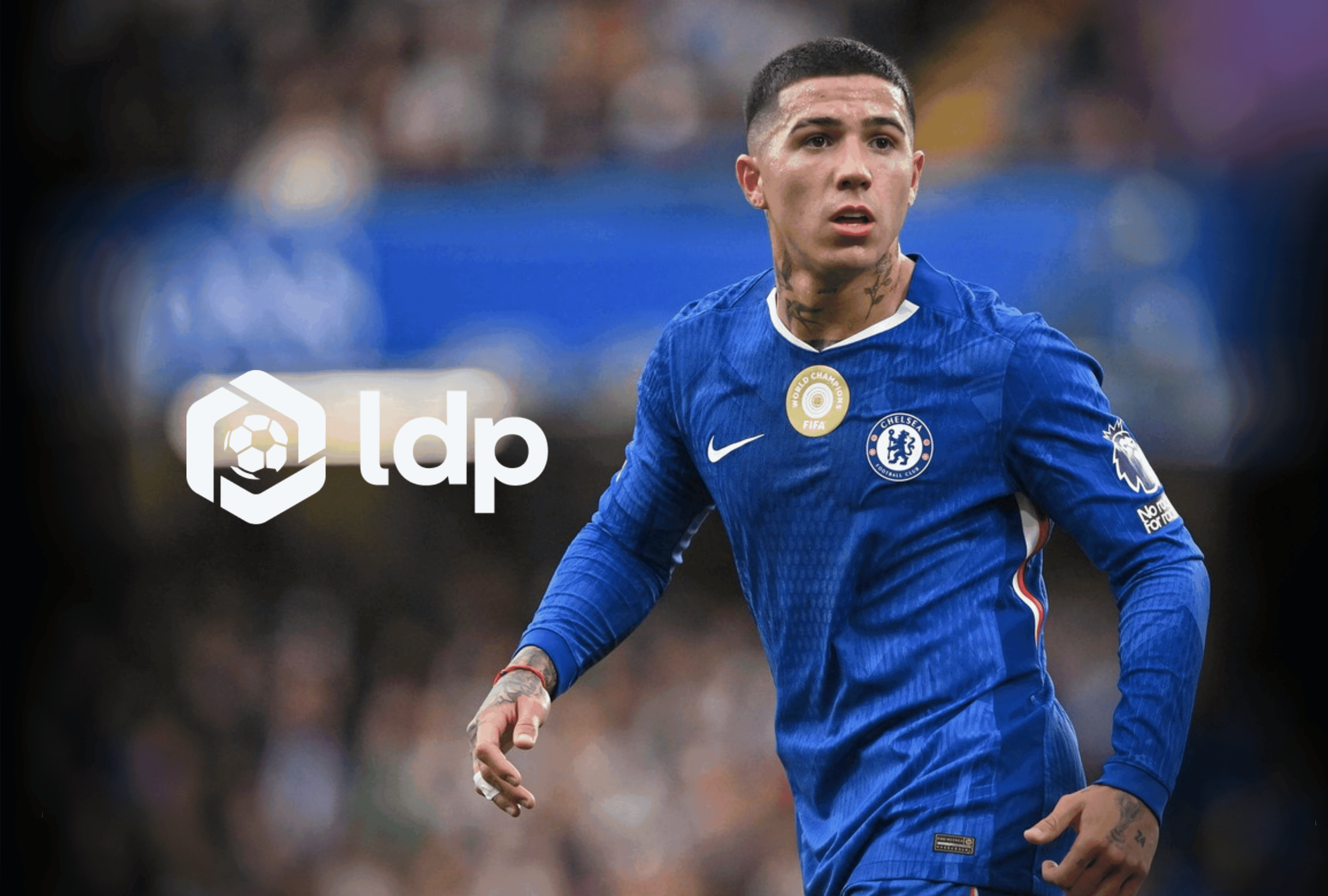
There is something that holds true in both scenarios: it appears as a natural option to organize the midfield. It can set the rhythm, provide continuity, and leadership, with influence in different areas of the field.
Our matching today is clear:
● Real Madrid: 78%
● PSG: 67%
Real Madrid: order and control in a sensitive area
Real Madrid has been following him for a while and is looking for solutions in a particularly delicate sector after the departure of Toni Kroos. In that context, Enzo can provide:
● Precise transitions to progress without losing control.
● Fluid circulation to maintain dominant possessions with vertical intent.
● Tempo management to organize the team in long phases and also in back-and-forth segments.
The nuance is that the club is going through a period of adjustment on the bench, and that type of change introduces relevant variables: the weight of the role, the structure of the midfield, the distribution of responsibilities, and, above all, the automatisms that make an organizer have immediate impact. In summary: in Madrid, Enzo fits as a structural solution. A piece to return control and stability to an area that defines the functioning of the team.
PSG: continuity of model, but need for answers
PSG, for its part, shows greater continuity under the leadership of Luis Enrique, although the context demands answers. The team is navigating a moment of pressure: second in Ligue 1, tough elimination in the Coupe de France against Paris FC, and irregularity in key matches.
In that scenario, Enzo fits by profile and by necessity:
● Immediate impact + projection (performance today, value tomorrow).
● Ball control to break first lines and gain meters.
● Physical deployment to sustain back-and-forth and pressure.
● Tactical reading to organize heights and compensations.
● Experience in high-demand environments, playing a leading role in recent competitive scenarios.
The difference in PSG: what Enzo adds to an already populated midfield
PSG has high-level midfielders like João Neves, Vitinha, Fabián Ruiz, and Zaïre-Emery. Still, there is a trait that doesn’t appear with the same combination in the current options and that Enzo does offer: competitive aggression, presence, and personality to influence the game by making the team play. It’s not just about “technical quality.” It’s the kind of interior player who can organize the team while competing in every duel as if deciding the match.
How PSG plays and where Enzo fits
PSG's historical dominance was built from the midfield: fluidity with the ball and intensity without it. In possession, the identity is clear:
● multiple variations,
● constant positional rotations,
● high technical level,
● width to stretch the field,
● search for 1v1 and attacking the area with many players.
Without the ball, they press high and maintain a compact block, among the most intense teams in the competition. In attack, that fluidity often culminates in the deep projection of the fullbacks, especially on the right. The coordinated movements between Achraf Hakimi and João Neves, generating numerical superiority near the area, are a key piece of the system. This is where the ideal role for Enzo appears: the interior player who connects the own half with the final third, sustains the rhythm, and powers a scheme that demands game reading, synchronization, and tempo control.
Conclusion: fits into both, but for different reasons
Enzo fits into both projects, but the “why” changes:
● Real Madrid: structural solution to provide order and control in a sensitive area.
● PSG: differential piece to add competitive character and internal connection within a high-demand system.
The difference is marked by context and timing. Because fit is not just about profile: it is also about timing, role, and ecosystem.
At LDP, we turn that into actionable signals to anticipate demand, understand context, and identify the right moment before the market moves.
Other publications


