
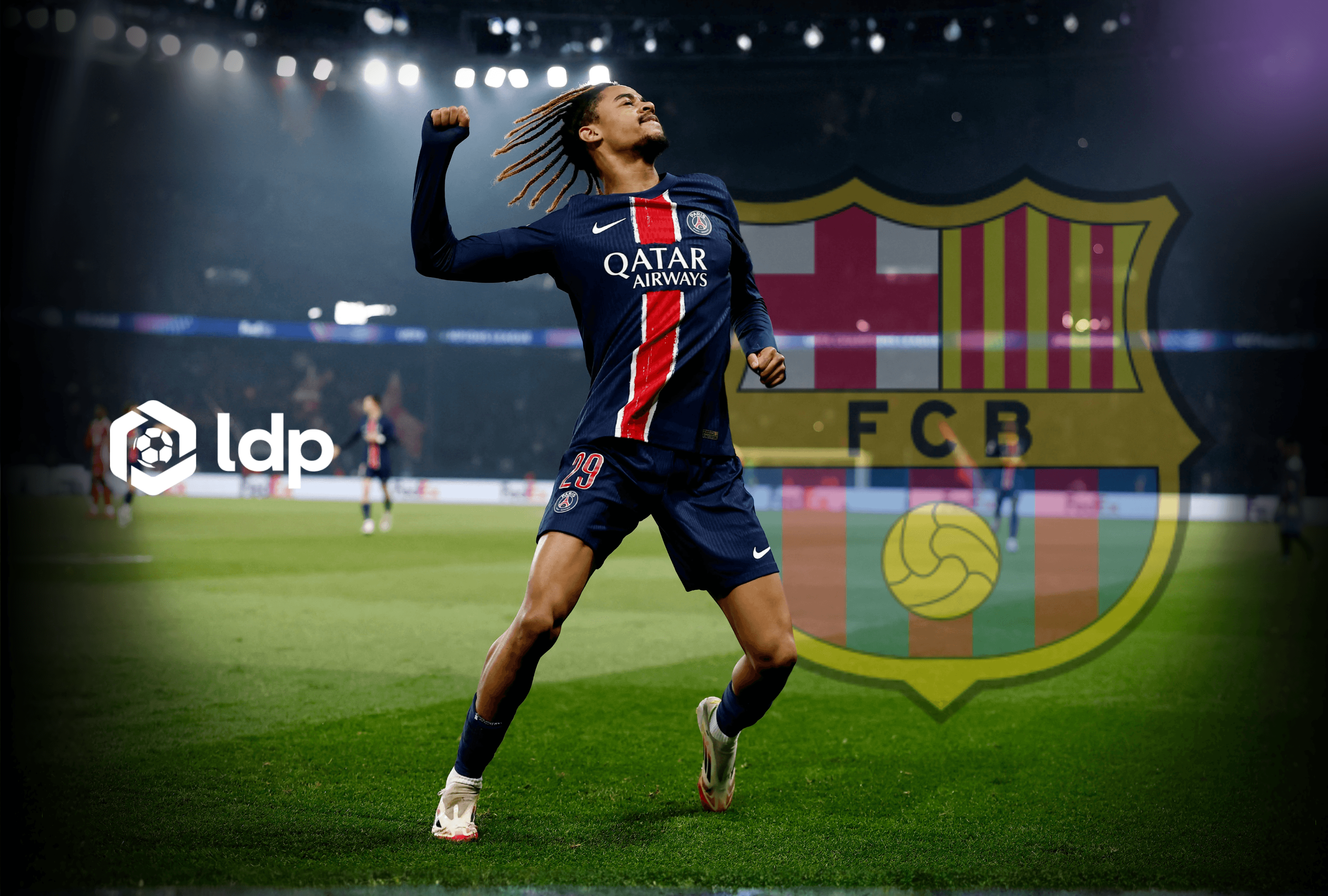
In elite football, there are moments when everything seems to happen with an uncommon naturalness. That state, studied by psychology and neuroscience as flow, appears when talent, execution speed, and game reading align precisely. There, performance gains fluidity, decisions come clearly, and the complex begins to seem simple.
At just 23 years old, Bradley Barcola has established himself as one of the most promising talents in French football, to the point of attracting interest from clubs like Barcelona in recent months. His recent injury, a severe sprain in his right ankle that will keep him out of competition for several weeks, interrupts a very marked growth moment but does not alter the overall reading of his profile. His game conveys a clear feeling: everything seems easy. He controls the pace of the actions without forcing them, finds spaces before they exist, and executes at speed with precision, resolving complex situations with naturalness. It's a profile that stands out not only for what he does but also for how he does it.
Metrics that explain his impact on the game
Beyond perception, the data supports his growth and relevance:
Top 1 in deep attacks in Ligue 1
Second in touches inside the box
Fastest player in the league: 34.8 km/h
Top 3 in offensive contribution (xG, goals + assists)
Cumulative xG of 7.3
Average of 2.2 key passes every 90 minutes
Barcola not only participates but also influences the rival game. His acceleration and ability to attack spaces make him a constant threat, especially in transitions.
Additionally, he has evolved in other key aspects, such as a greater tactical awareness, improved decision-making, and growth in finishing. This progress is reflected in his numbers, going from 5 goals in 42 matches to 12 goals and 5 assists in the current season.
Tactical profile: the winger that breaks structures
Barcola is, by nature, a left winger. However, his versatility allows him to also play on the right, adapting to different offensive contexts.
His main strengths:
Speed dribbling
Ability to attack spaces with long dribbles, maintaining precision at high intensity.One-on-one in tight spaces
Efficient use of the inside and outside of the foot, combined with changes of pace and direction.Attacking spaces
Constant reading of defensive gaps, especially in low blocks.Finishing on the move
Tends to start with a dribble, cut inside, and finish with unpredictable profiles.
In a context where many teams face closed defenses, his ability to generate depth and disrupt structures becomes differential.
While his evolution is evident, there are still areas where he can continue to grow, especially in the consistency of his finishing, his ability to maintain high levels of intensity for longer, and the development of his competitive mentality in high-demand scenarios. The talent is clear; the next step will be to consolidate that impact in a sustained manner.
How could he fit into F.C. Barcelona?
From a market logic, his profile brings together several of the conditions that top-level clubs are looking for today: youth, imbalance on the wing, immediate impact capability, and future development potential. Additionally, he has a tactical adaptability that allows him to respond to different offensive contexts and needs. In the case of Barcelona, that fit becomes especially clear due to the need for offensive depth, profiles that break lines, and players capable of providing imbalance in structures that require interpreting spaces well. Within a project that combines present and development, his profile appears as a very aligned option. Furthermore, his current situation opens a window of opportunity: he remains a valuable asset but not necessarily an immovable piece.
In today's football, detecting talent is no longer enough. The real differential lies in understanding in what context that talent can best express its potential. It's not just about knowing who performs well, but identifying which clubs need that profile, in what tactical structure it can be enhanced, which leagues favor its characteristics, and what is the right moment for that movement to occur.
Because a player's performance does not depend solely on their individual conditions but also on the environment that receives them. Therefore, from a market intelligence perspective, the analysis is not limited to the name itself but to the relationship between player, club, and moment. That is where the true quality of a market decision is played out.
In this sense, he also represents much more than an emerging talent. He represents a way of playing where speed does not imply chaos, creativity does not need exaggeration, and decision-making appears with an uncommon fluidity. That state, the flow, is not random: it arises when talent, context, and confidence align precisely. And when that happens, the game regains one of its most difficult-to-explain yet easiest-to-recognize forms: making simple what for most remains impossible.
Other publications


